MAKING CHANGE artists for change

MAKING CHANGE artists for change

Pages

Tuesday, October 5, 2010

Interview with Shawn P. Wilbur of Corvus Editions


[Above: "Helen Keller Bottlecap Pin" by Corvus Editions]

The MAKING CHANGE Etsy team is for artists committed to activism. Please tell us what issues are important to you.

Liberty, environmental and social sustainability, and teaching the history of those ideas. I'm a mutualist anarchist, but my cultural work covers a lot more ground than that.

How is the idea of activism apparent in your art?

My work is essentially educational. I worked for years as a bookseller and university instructor, and then that work went away with the changes in the economy. So I've found other means to at least try to keep doing that same work. The works that I publish and the images that I use in my art are all drawn from my researches into radical history. In some cases I've drawn book-design elements from radical presses of the past.

I try to use recycled or repurposed material for almost everything. Most of the paper I use is produced from farm-waste. My books are nearly all covered either with wall-covering, upholstery samples or paper I've made at home from junk mail and scraps. It's a constant learning experience, working with scrap material, and I try to share as much as I can of what I learn.

[Left: " E. Douglas Fawcett, Hartmann the Anarchist - 1893"
by Corvus Editions]

Do you think political and environmental issues can be effectively addressed in art?

Yes. Of course. There are so many examples of powerful political art. There's a lot that art can't do, in terms of addressing very specific issues, but many of those issues can be addressed by artists and other cultural workers. I find that I'm increasingly foregrounding the scrap elements in my work, and highlighting the seams so that people can see what can be done with material that was essentially waste, and maybe see enough to try it themselves.

Which artists do you admire who have an activist agenda?

The Just Seeds group, the Beehive Collective.

Tell us something about your process of creating.

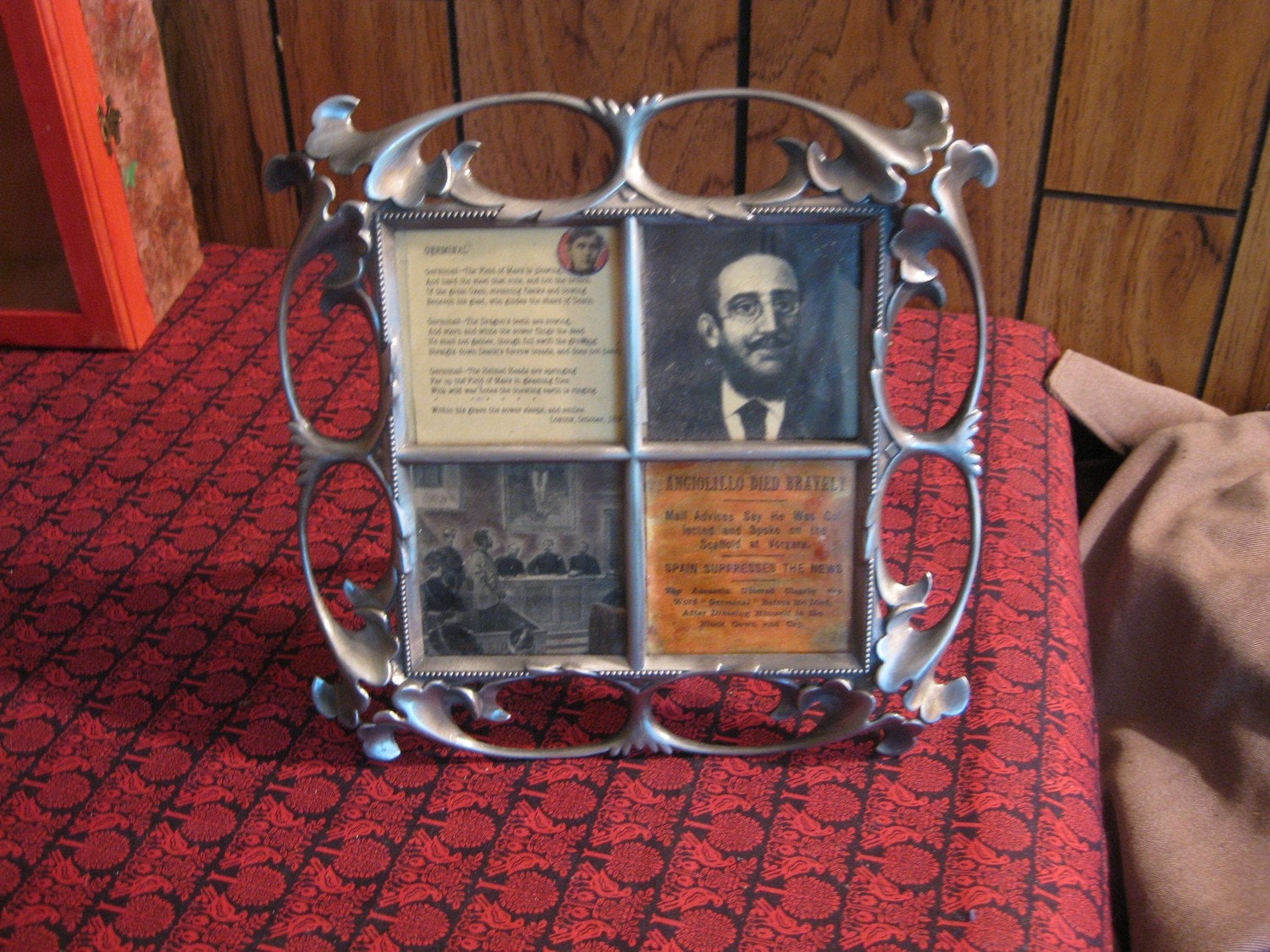
[Right: "Voltairine de Cleyre - Germinal - framed poem and pictures of Angiolillo" by Corvus Editions]

I start with historical research, and collect texts and images. Some of the things that I collect sort of push themselves forward, generally because they seem to have something important to say in the present context. I have a general aesthetic, roughly neo-19th-century, to complement the sources, and a bit primitive, which is partly a matter of letting the seams show and partly me playing to my personal strengths. I try to make everything I put together sturdy, and obviously so, so that people will be less hesitant to pick things up and use them. For the most part, I print text and images in black and white and add color by hand, so each item is at least a little different from the others. I tend to work fairly quickly once I'm really producing items, but I do a lot of experimenting in the early stages of each project. A test book-binding may end up riding around in my satchel for a month before I decide it's durable enough to run with.

What is the name of your etsy shop? CorvusEditions

Sunday, October 3, 2010

Fantastic opening of the MAKING CHANGE store yesterday!

Huge opening reception at 18th. Street Arts Center yesterday..great response to Making Change store..powerful art! Come see ..open Thur/Fri/Sat 12:30 to 5pm till Dec. 23rd!

Friday, October 1, 2010

MAKING CHANGE STORE at 18th. Street Arts Center opening Oct. 2nd.

ElenaMary
ElenaMary says:
My "artist in residence store" at 18th. Street Arts Center in Santa Monica is opening Oct. 2nd...Etsy sellers are represented along with many of the best political artists in Los Angeles. The MAKING CHANGE Blog features only etsy sellers who are members of the MAKING CHANGE ETSY TEAM..some of whom are represented in the actual store..Contact me if you create political work and would like to be interviewed for the MC blog:


Those of you in Los Angeles please come and visit me in the store..days and hours are: Wed/Thur/Fri/Sat 12:30 to 5pm

http://18thstreet.org/projects/making-change-elena-siff

Monday, September 20, 2010

Interview with Jen Wojtowicz


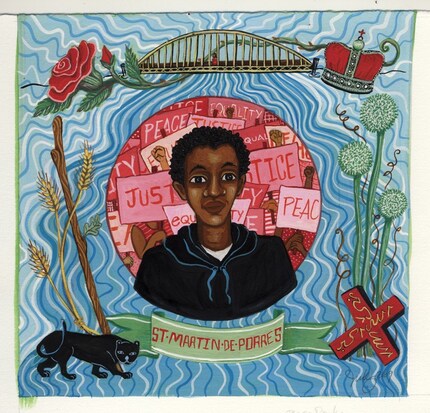
Above: "St. Martin de Porres--Justice Equality Peace" by Jen Wojtowicz

What issues are important to you?
Human rights for all people and saving our planet.

How is the idea of activism apparent in your art?
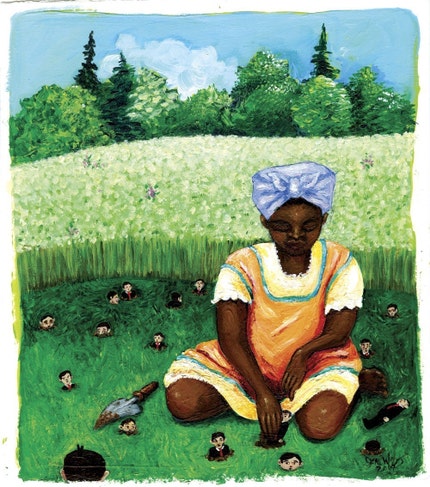
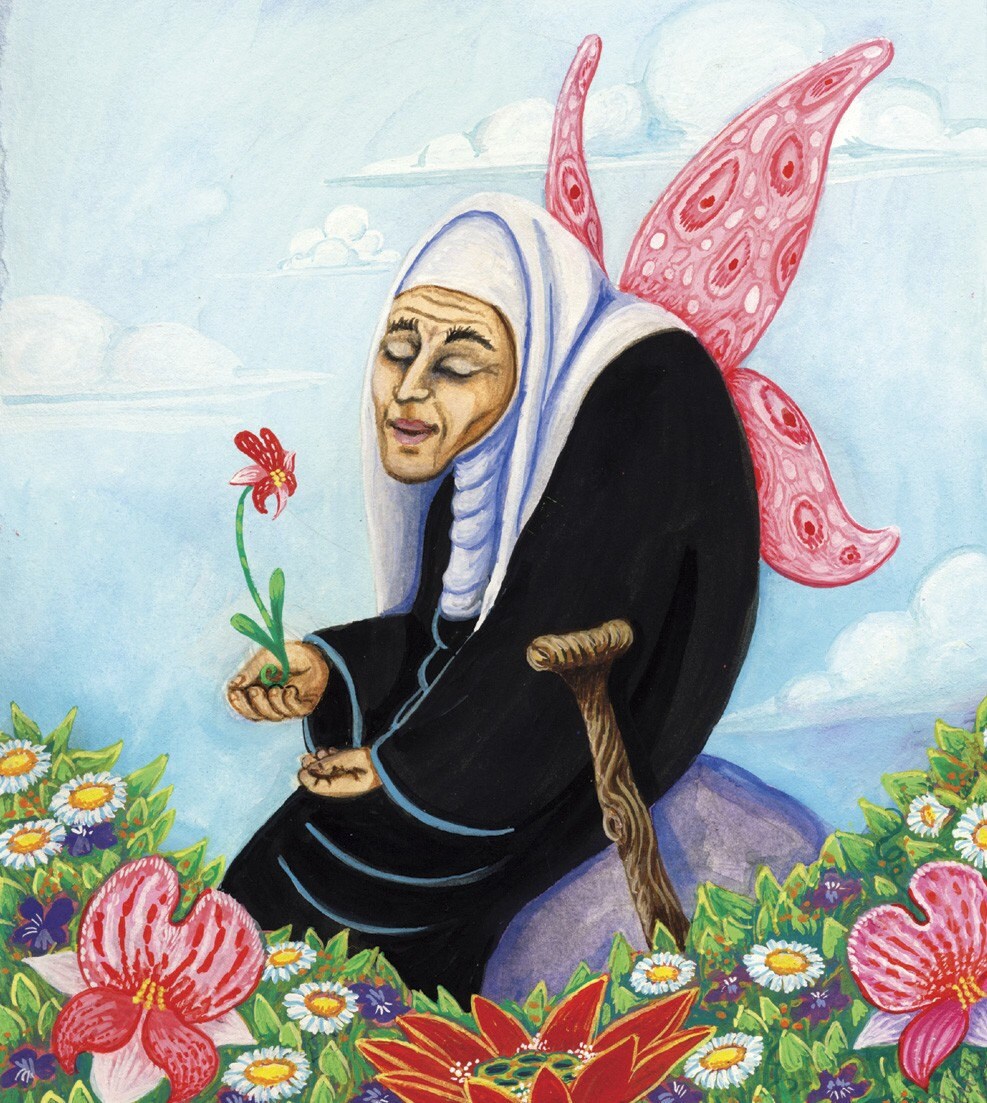
I represent all people in a reverential way. I am inviting the viewer to reconsider traditional Western images of the holy and sacred, which have been commodified, homogenized, and really only represent one group of (white) people. I am inviting the viewer to consider the holy and sacred nature of people who have been disregarded, discriminated against and treated very badly in the United States on the basis of their color, ethnicity, religion, sexual orientation, mental heath issue, disability, or economic situation. I am inviting the viewer to examine what is in their hearts and minds, and to think in a different way if need be. I am inviting the viewer also to consider the wisdom and sacredness of all spiritual traditions. I also frame issues in the context of a holy person or saint, like addressing racism in a St. Martin De Porres (patron saint of African-American people and of social justice) or the destruction of nature in the painting "St. Dorothy, Patron Saint of Gardeners, Buries Land Developers to Make Room for a Field" (at right).

Do you think political and environmental issues can be effectively addressed in art?
Oh yes. Art can effectively translate an idea or an emotion into something tangible. And an image can be a powerful thing, it has a way of staying with you, of speaking to the heart of the matter.

Which artists do you admire who have an activist agenda?
Definitely my husband, Marcus Kwame Anderson, also Dwell, South African graffiti artist Faith47, Ricardo Levins Morales, Nathan Meltz, and the Just Seeds Artists Cooperative, and James Koyote Staley.

Left: "St. Margaret of Castello/God Made Us Perfect" by Jen Wojtowicz

Tell us something about your process of creating.
I'm always telling myself a story when I paint, or build a shrine. I have to get to a certain place internally, where the story or the feeling is directing my hands and my decisions about the piece.

What is the name of your etsy shop? JenWojtowicz

Saturday, September 4, 2010

MAKING CHANGE STORE TO OPEN on Oct. 2nd

Official opening is Oct. 23rd. but actual opening is on Oct. 2nd. from 1 to 6pm at the Beer/Music/Art benefit event!!

Friday, August 27, 2010

Interview with Q and 17thletter Photography

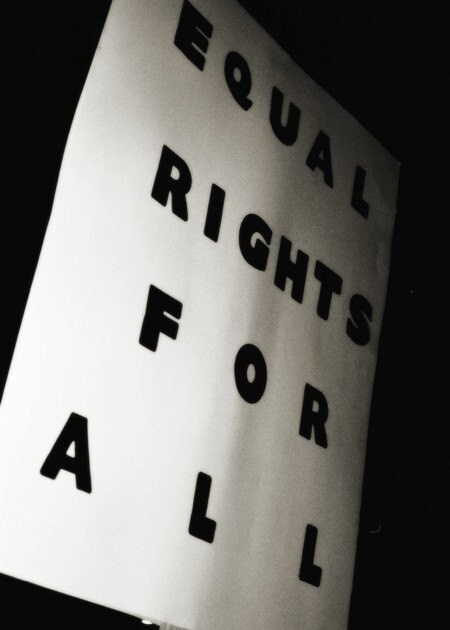
[Above: "Equal Rights for All" by Q]

The MAKING CHANGE Etsy team is for artists committed to activism. Please tell us what issues are important to you.

-This is a pretty tough question to answer concisely as there are many issues that are important to me and there are also issues that I'm not knowledgeable of that I find that are still important. My utmost concern are the social issues. Poverty, race relations and perceptions especially when it concerns with government and law, immigration reform etc. I find that my need to make all things as fair as possible makes me more passionate about social issues than say...the foreign wars this country is active in or that of environmental issues.

How is the idea of activism apparent in your art?

There are two methods in which I try to convey activism with my photography. A lot of the times, I'll make the subject matter of my photography outright and out there so that the viewer knows what it is I'm actually trying to convey. With this method, I'm pretty much going with the photojournalist's perspective of getting the shot. No cloud, confusion or gray area. Then there are times when I take a subtle approach. These come few and far between because they're the hardest to successfully accomplish. I'm quite fond of these works because I feel that I can engage a viewer into thinking about the issue more and hopefully change their minds, should their views on the subject be different from mine.

[left: "Sold on the Dream" by Q]

Do you think political and environmental issues can be effectively addressed in art?

Emphatically yes! There are so many great artists out there who are successful in getting the message out...either the artists' own or the issue at hand. One name that comes to mind is Shepard Fairey. His whole Obey propaganda has influenced me a great deal and has helped build my social activism and I'm quite sure many others out there have been influenced by his work. What's so great about him, and many other street art and street artists out there is that their work is accessible to everyone because they're readily available out on the streets and not solely in art galleries. Street art is a great medium in which to spread a message or idea/issues out. On the other side of the coin though, it's a sad thing to find that many works are overlooked because the general consensus is that such works are the works of vandals or plain graffiti. I beg to differ though. This is the people's art.

Which artists do you admire who have an activist agenda?

Well, because I've already named Shepard, I can't really use him for this one huh, lol. So, other than him, I'm also a big fan of Estevan Oriol's work although to be honest, I'm not quite sure if some of his works are overtly political. I would like to think that said works, are in the very least, subversively political. How can it not be? Even if it is unintended, I find that a lot of his street photography, and his photographs of the many gang members he's taken, speaks about many of the social issues that I myself try to show the world.

[right: "No to H8" by Q]


Tell us something about your process of creating.

My process of creating is that...I have none. I probably shouldn't have said that but I'm being honest. I'm always with a camera or two and when I go out, I go out to capture the world in all its beauty. As sad and as heart wrenching as some of some of these social issues can get, I find a certain beauty to them because in the end, it really is just a beautiful struggle. Take that however you want to take it. I just try my best to capture while at the same time being fair and honest if that makes any sense.

What is the name of your etsy shop?

The name of my store is PhotographyofQ. I'm still working on a series of photos called "A Beautiful Struggle" that deals with social issues and as far as I'm concerned, it'll always be a work in progress...

Monday, August 2, 2010

Interview with Celeste Christie and Steve Damewood of Art for a Democratic Society


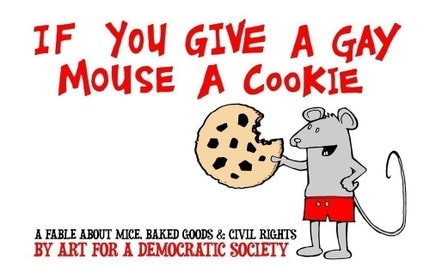
Above: "If You Give a Gay Mouse a Cookie" by Art for a Democratic Society

Please tell us what issues are important to you.

A4DS tackles a lot of different issues; we tend to focus on different political or local issues as they come up. Politically, our views are left-wing and there are many things about modern society that we think should change, and know can be different, but we don’t see A4DS as a way to initiate independent political actions; that is the role of grassroots activism in our view. Some of our goals or hopes are to be able to lend some support to existing movements as well as initiate public political exchange and debate on political issues. So, for example, we supported a labor action by locked-out Waste Management workers helping on the picket line as well as setting up a table in Oakland with markers and poster board and asking passersby to help create picket signs. In a small way, with projects like this, we can both lend concrete “artistic” support to an immediate cause, but also engage people around immediate issues in what we hope, is a fun and unexpected way. In addition to that labor action, we've done projects and pieces about the death penalty, gentrification, the economic crisis, elections, as well as art history, theory, and aesthetics.

How is the idea of activism apparent in your art?

Activism is central to what we do. What we make is really ancillary to a wider project usually conducted in the public sphere. Lately, we've been partnering with activist organizations to create cultural responses to issues at hand.

We also hope it comes across in the manner that we operate and conduct our art projects. We not only stress grassroots discussion about political issues, but take a participatory and grassroots approach to our projects as well. One of our ongoing regular projects is called “The Polarizer” which is just a big blank tablet that has been divided into two columns. We set the tablet on an easel at a street corner and have people weigh-in on one side or other of a particular issue by writing a response on the appropriate side of the tablet. Some months, the question is a straightforward one with the responses acting as sort of an impromptu straw poll of an issue. Other months, the question is more abstract and so we might ask people to write their version of “utopia” on one side of the tablet or their idea of “dystopia” on the other.

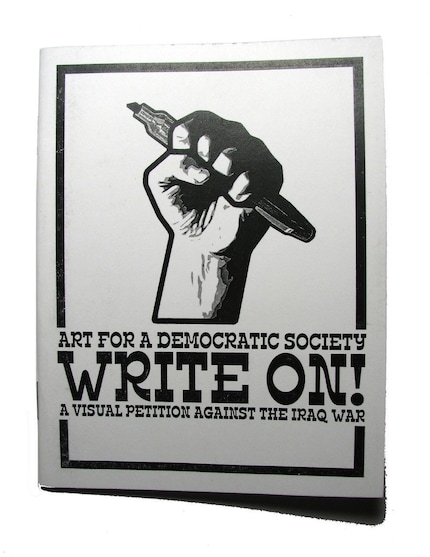
Right: "Write On!" by Art for a Democratic Society

Do you think political and environmental issues can be effectively addressed in art?

That's kind of a tricky question. What do you mean by "effectively addressed?" We think political art can be effective as art. We don't think political art by itself can be effective in creating social change. However, if we look at the history of social movements, art movements and cultural movements are intertwined within them. Artists can react to social struggles and create cultural directions that aid political movements, but political organizing is essential to social change.

Which artists do you admire who have an activist agenda?

Jeremy Deller, the Yes Men, Banksy, Favianna Rodriguez, Melanie Cervantes and Jesus Barraza, Packard Jennings. We are also in awe of many in the generation of artists who were politicized by the events of the early 20th century such as the horrors of World War I, the movements of the Depression-era, and opposition to fascism. Many of these well-known artists like Diego Rivera, Bertolt Brecht, George Grosz, John Heartfield, John Steinbeck and George Orwell chose to use their skills to try and address or reflect the changes going on in the world.

Tell us something about your process of creating.

One of us comes up with a kernel of an idea, usually when we're pissed off and talking about the latest political issue, and then we talk it out to expand it into something. Usually then we decide
whether it's something we'll make together or run with on our own for a while.

Left: "Community Consensus Manifesto" by Art for a Democratic Society

We try not to be mechanical about it: we don’t just read the headlines and pick one to talk about. So it’s always something that we’ve been talking about, something immediate like the prop 8 vote or a local strike, or something that a lot of people around us at work or socially have been discussing and arguing about.

Once we have a basic idea of the issue we evaluate different ideas about how to present it. What we always try and consider is if it is open enough that we aren’t simply fishing for people to come to the same conclusions we may have, but that it’s specific enough to be challenging and hopefully elicit debate.

The way our political bias does fit into our process is in what issues we choose to highlight and the way in which we do. We don’t see change coming from establishment political parties, but through social movements, so when something like Prop 8 comes up, we tend not to have projects focused on the legal and constitutional issues involved (such as court challenges and lobbying and so on) but on the grass-roots side of the issue.

What is the name of your etsy shop?

http://a4ds.etsy.com

MORE ABOUT THE ART FEATURED ABOVE:

This is the result of one of our favorite projects, the Community Consensus Manifesto. We did a poll at Oakland's First Friday art walk asking people questions about art and its place in society, based on an agree/disagree scale of 1 to 5. The questions were statements taken from various art manifestos. Based on people's responses, and using an elaborate methodology, we created a consensus manifesto.

Another favorite project of ours, Write On! is a compendium of anti- war posters "defaced" by volunteers at First Fridays. We printed templates of anti-war posters publicizing a protest, featuring George W. Bush, Hillary Clinton, and Harry Reid and Nancy Pelosi, and then asked people to deface them. There was a wide range of responses, from violent (tearing out the face on one poster), to juvenile, to clever, to serious. We compiled the results in this zine, and put up
the original posters around town.

If You Give a Gay Mouse a Cookie is a little different in that it's all our original content and not a community collaboration. We came up with the story and dialogue together, and Steve illustrated it. It's a parody of the children's book "If You Give a Mouse a Cookie," and a parable explaining the Paris 1968 slogan "with the eating, comes the hunger" from the standpoint of the gay rights movement, specifically the right to marriage. It's also appropriate for children (though not too young, maybe).